 Tours
Tours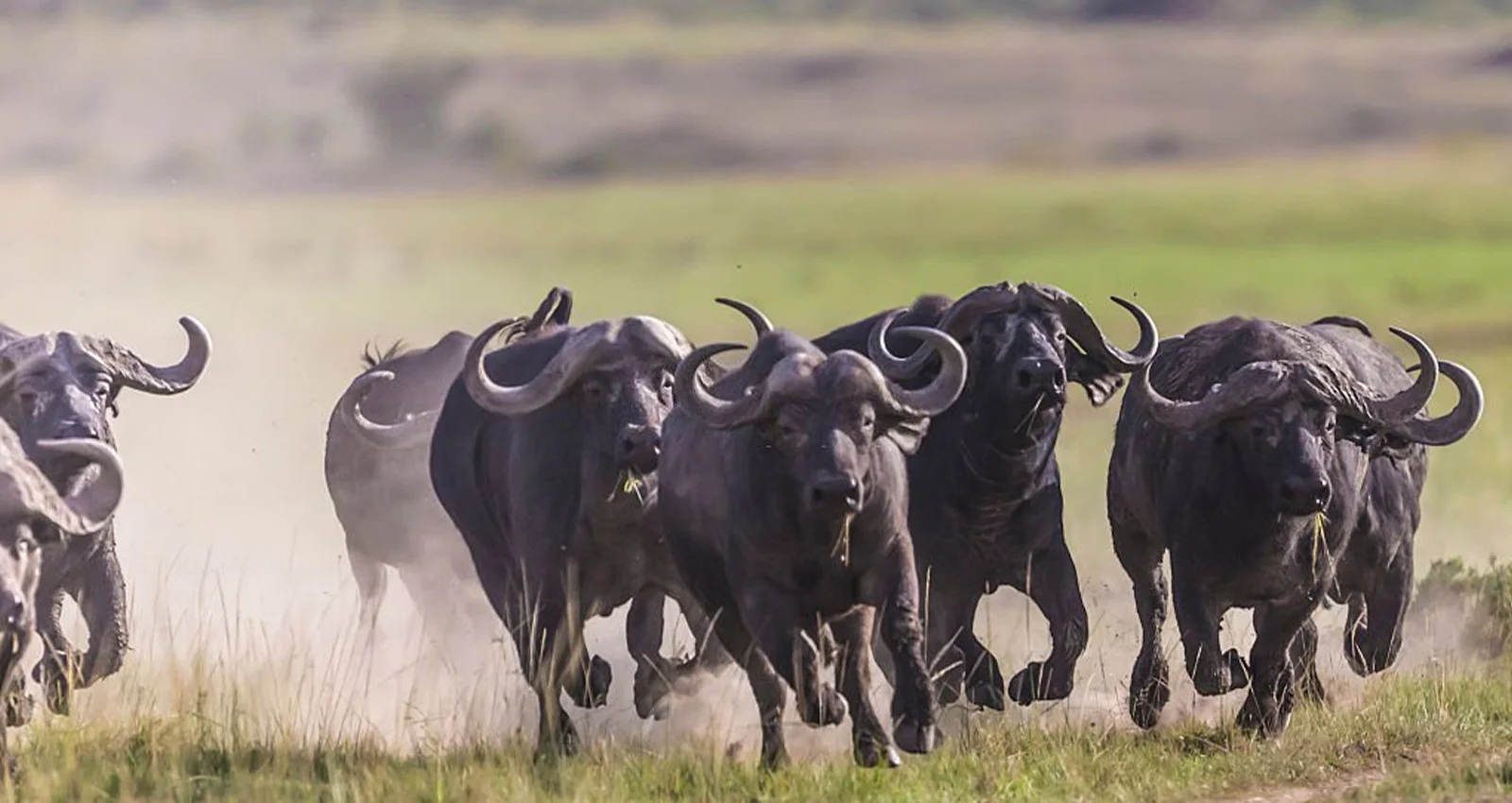
NoMiddleManTours · Jun 22, 2026 · 12 min read
A guide-grade field guide to Cape buffalo in Tanzania — the biggest herds in the Ngorongoro Crater, Tarangire and Katavi, why the lone old bulls (the dagga boys) are the dangerous ones, and how a herd actually fights off a lion pride.
Cape buffalo are the most underrated of the Big Five and, by the numbers, the most lethal — credited with more human deaths than lion or leopard. Yet most safari-goers drive straight past a grazing herd looking for cats. That is a mistake. Tanzania holds some of the largest buffalo herds left in Africa: a dense resident population on the Ngorongoro Crater floor, dry-season concentrations in Tarangire, and the staggering thousand-strong herds of remote Katavi in the west. This guide tells you exactly where to find them, why the solitary old bulls earned the nickname "Black Death," and the one piece of buffalo behaviour every guide hopes you get to witness — a herd turning on a lion pride and winning.
 Destination
Ngorongoro Conservation Area
conservation_area
The short answer: where to see Cape buffalo in Tanzania#
Buffalo are resident across almost every Tanzanian park, so a sighting is close to guaranteed on any multi-day safari. The question is not whether you will see one — it is whether you will see the spectacle: a herd a thousand strong, or a tense stand-off with predators. Here is where each happens.
| Where | Herd character | Best months | Why it stands out |
|---|---|---|---|
| Ngorongoro Crater | Dense resident herds, big old bulls | Year-round | Easiest big-herd viewing; predators in the same bowl |
| Tarangire | Hundreds gather along the river | Aug–Oct (peak dry) | Buffalo concentrate as outside water fails |
| Katavi | Herds of 1,000+ — Africa's largest | Aug–Sep | The single greatest buffalo spectacle on the continent |
| Central Serengeti (Seronera) | Resident herds + dagga boys near water | Year-round | Frequent lion-versus-buffalo drama |
The honest planning takeaway: if you simply want buffalo ticked off, any northern-circuit safari delivers it within a day. If you want the goosebump version — a herd that fills the windscreen, or a clash with lions — weight your trip toward the crater floor, Katavi, or Tarangire in the dry season. Buffalo are non-negotiably part of the Big Five, so they come for free on the route you are already planning; the trick is knowing where the numbers peak.
What a Cape buffalo actually is — and why it is on the Big Five#
The Cape buffalo (Syncerus caffer caffer) is the largest of Africa's buffalo subspecies: a bull weighs 600 to 900 kg and carries a fused boss of horn across the skull that works like a built-in crash helmet. They are not the lumbering cattle they resemble. A buffalo can run at roughly 55 km/h, pivot on the spot, and — unlike most prey animals — will deliberately circle back to charge a pursuer it has already shaken off.
That last trait is exactly why buffalo made the Big Five. The term comes from colonial-era hunting and ranks the five animals once judged most dangerous to hunt on foot: lion, leopard, elephant, rhinoceros and Cape buffalo. Buffalo earned their place not through size but through temperament. A wounded one does not flee; it lies up in thick cover, waits, and ambushes whatever followed the blood trail. Professional hunters have a blunt phrase for the look a buffalo gives you down its nose — like you owe it money. On a photographic safari you are in a vehicle and in no danger, but the wariness is genuine: your guide will keep a respectful distance from a lone bull in a way they never would from a herd of impala.
The dagga boys — why the lone old bulls are the dangerous ones#
Here is the insider distinction that separates a real buffalo sighting from a generic one. The buffalo that kill people are almost never the big breeding herds. They are the dagga boys: old bachelor bulls, usually past their breeding prime, that have been pushed out of the herd by younger, stronger males. The name comes from the Zulu and Shona word dagga, meaning mud — these bulls spend their days wallowing, and a thick crust of dried grey mud cakes their flanks like armour, both to cool down and to smother the ticks they can no longer outrun within the safety of a herd.
Why are they the dangerous ones? Three reasons a 20-year guide will tell you. First, they are alone or in tiny groups of two or three, so there is no herd to alert and no herd to dilute a predator's attention — a dagga boy is on a permanent hair-trigger because it is the only thing standing between itself and a lion pride. Second, they have nothing to lose; ejected from the breeding pool, an old bull's only remaining job is to survive, and survival means aggression first, questions later. Third, they hold close to water — riverbanks, swamp edges, waterholes — which is exactly where vehicles and walking parties also go, so the unlucky encounters happen there. Look for them at the Seronera marsh fringes in the central Serengeti, along the Tarangire River, and on the Katuma River banks in Katavi. A dagga boy facing you head-on, mud-grey and motionless with its nose slightly raised testing the wind, is the most photogenic and the most loaded buffalo image you will get — and your guide will read its body language carefully before letting the engine idle.
The "Black Death" reputation — fact versus folklore#
You will hear Cape buffalo called the "Black Death" or "the Widowmaker." The reputation is largely a hunting-era inheritance, built on those wounded-bull ambushes, and the statistic most often quoted is that buffalo kill around 200 people a year in Africa. That number is real but needs context: the overwhelming majority of those deaths involve dagga boys surprised at close range — hunters tracking wounded animals, herders and farmers crossing buffalo ground on foot, not tourists in vehicles. A buffalo's defence is a head-down charge using that horn boss as a battering ram, followed by hooking and trampling; it is the follow-up, not the first hit, that does the damage.
For a photographic safari the practical reality is reassuring and simple: buffalo are not predators and have no interest in a Land Cruiser. The danger is exclusively a function of being on foot near a lone bull, which is precisely why walking safaris are guided by armed rangers and why guides never approach a dagga boy on foot without one. Respect the animal, stay in the vehicle when asked, and the "Black Death" stays a great campfire story rather than a real risk.
Herd defence — how buffalo fight off lions#
The single most thrilling thing a buffalo herd does is the reason cats both depend on them and fear them. Lions are the only predator that routinely takes adult buffalo, and a big herd is one of the few prey species that fights back as a coordinated unit rather than scattering.
When lions press a herd, the buffalo bunch into a tight defensive mass with calves in the centre and the heaviest bulls on the outside, horns out — a living wall. Then they do something almost no other prey does: they counter-charge. A cornered or threatened herd will wheel as one and run at the lions, and bulls will single out and toss a lion clean into the air with a flick of the boss, or pin a pride member against the ground. The phenomenon safari guides call "mobbing" — buffalo actively hunting down and goring lions that have killed a herd member, sometimes a calf — has been filmed repeatedly; the most famous footage, the so-called "Battle at Kruger," is from South Africa, but the same drama plays out wherever big herds and big prides share ground in Tanzania. The central Serengeti around Seronera, the Ngorongoro Crater floor, and Katavi are the prime arenas because the herds and lion densities are both high. It is a long-odds sighting on any single drive, but if a guide spots a pride shadowing a herd at dawn, that is the moment to abandon the leopard plan and wait. A buffalo herd defending its own is the rawest expression of the savanna's power balance you will ever watch.
The big herds: Ngorongoro Crater, Tarangire and Katavi#
Three places in Tanzania deliver buffalo in numbers that change the experience from a sighting into a spectacle.
The Ngorongoro Crater floor carries one of the densest resident buffalo populations anywhere — a permanent herd grazing the open grassland and the Lerai Forest fringes, in the same enclosed 264-square-kilometre bowl that holds the country's best lion and black rhino viewing. Because everything is concentrated, the crater is the easiest place in Tanzania to see big buffalo herds and predators in a single morning. A crater day runs on a fixed clock: the conservation-area fee is US$82.60 per adult per 24 hours, plus a US$295-per-vehicle crater service fee for the descent and roughly US$40 for the mandatory ranger; you descend the Seneto road by 6 AM and must be off the floor within six hours, ascending via the Lerai road.
In the dry season from August to October, the Tarangire River becomes a magnet. As seasonal pans and rivers outside the park dry up, buffalo — along with the famous 3,000-plus elephants — concentrate along the permanent river in herds of several hundred. Tarangire in the dry months is one of the most reliable places in the north to watch a large herd come down to drink at dusk, with lions never far behind. All northern parks run gates from 6 AM to 6 PM with no driving after dark.
But the true headline act is Katavi, Tanzania's third-largest and most remote national park, deep in the west and reachable only by a 3-to-4-hour charter flight. In the peak dry months of August and September, as the Katuma River shrinks to a muddy trickle, buffalo gather in herds that can exceed a thousand animals — among the largest buffalo concentrations left on Earth — alongside pools crammed with 600+ hippos. You may genuinely see more lions than other tourists here. It is fly-in only and the camps close entirely from November to May when the rains scatter the game, so it is a June-to-October destination by definition. If a herd that fills the horizon is the image you are chasing, Katavi is where to chase it.
 Destination
Katavi National Park
national_park
For travellers who want exactly that western-wilderness experience — the thousand-strong herds and near-empty park — the fly-in route below is the cleanest way to reach it.
Itinerary4-Day Katavi Fly-In Wilderness Safari
4 days
When to go for the best buffalo viewing#
Buffalo are present year-round in every park, so the calendar is about numbers and drama, not presence.
| Period | What's happening | Buffalo angle |
|---|---|---|
| Jan–Mar | Green season, herds dispersed | Buffalo everywhere but spread thin; calving herds, healthy and glossy |
| Apr–May | Long rains; southern and western camps closed | Northern parks only; Katavi shut; lush but harder to find big herds |
| Jun–Jul | Dry season building | Herds start concentrating at permanent water; Katavi reopens |
| Aug–Oct | Peak dry | The window: Tarangire river-herds, Katavi 1,000-strong herds, intense predator pressure |
If you can optimise for one thing, August to October is the buffalo season: the dry-season water concentration effect packs herds together in Tarangire and Katavi and ramps up the lion-versus-buffalo tension. The Ngorongoro Crater, fed by permanent springs, holds its herds regardless of season, so it is the year-round insurance policy.
How to actually watch buffalo well#
Sightings are easy; good sightings reward a little knowledge.
Read the mud, not just the animal. A lone, mud-caked bull holding near water is a dagga boy — the most characterful buffalo portrait you will get and the one your guide will treat with the most caution. A clean, glossy-coated animal in a big mixed group is a herd buffalo.
Watch the oxpeckers and egrets. The red- and yellow-billed oxpeckers riding a buffalo's back are picking ticks, and a sudden flush of birds off a herd often means something — a predator — has spooked them. Guides read the birds before they read the buffalo.
Buffalo at dusk means predators nearby. A herd moving to water in the last light is exactly the setup lions wait for. If you find a big herd drinking at the end of the day, linger — that is when the savanna's best drama is most likely.
Start at first light. In Tarangire and the crater, with gates open only 6 AM to 6 PM and no night drives in the national parks, the cool first and last ninety minutes hold the most movement and the highest chance of a herd-predator interaction.
Where buffalo fit in your wider safari#
You do not build a safari around buffalo — you build it around the Big Five and the migration, and buffalo are the reliable, ever-present spine that ties it together. A classic northern-circuit trip gives you Tarangire's dry-season river herds, the Ngorongoro Crater's dense resident population, and the central Serengeti prides that hunt them, all in one loop. Add a western fly-in leg to Katavi and you graduate to the thousand-strong herds that almost no one sees.
If you would rather compare every Big-Five-focused route side by side — durations, regions and lodge tiers, with buffalo guaranteed on every one — start here:
See all Big Five safarisFrequently asked questions#
Where is the best place to see Cape buffalo in Tanzania? For sheer numbers, Katavi in the remote west holds the largest herds in Africa — over 1,000 animals in August and September. For easy, reliable big-herd viewing alongside predators, the Ngorongoro Crater floor is best, and Tarangire concentrates hundreds along its river in the dry season from August to October.
What is a dagga boy? A dagga boy is an old bachelor bull buffalo pushed out of the breeding herd by younger males. The name comes from the word for mud, because these bulls wallow constantly and wear a crust of dried mud. They live alone or in twos and threes near water, and they are the buffalo responsible for almost all dangerous encounters with people on foot.
Are Cape buffalo really the most dangerous of the Big Five? Buffalo are credited with around 200 human deaths a year in Africa, more than lion or leopard, which earned them the nickname Black Death. Almost all of those incidents involve lone old bulls surprised at close range by people on foot, not tourists in vehicles. On a photographic safari, buffalo pose no real danger as long as you stay in the vehicle near a lone bull.
Can a buffalo herd kill a lion? Yes. Big buffalo herds defend themselves as a coordinated unit, bunching with calves in the centre and counter-charging the pride. Bulls regularly toss lions into the air with their horn boss and can gore them fatally, and herds will sometimes hunt down lions that have killed a herd member. It is one of the rawest spectacles on safari.
What is the best time of year to see big buffalo herds? August to October, the peak dry season, is the buffalo window. As outside water dries up, herds concentrate along permanent rivers in Tarangire and Katavi, and the predator pressure intensifies. The Ngorongoro Crater holds dense herds year-round because of its permanent springs.
Do you have to go to Katavi to see large buffalo herds? No. The Ngorongoro Crater and Tarangire both deliver large, easily seen herds on a standard northern-circuit safari without a remote flight. Katavi simply takes it to another level — herds of 1,000-plus in a park so remote you may see more lions than other tourists — but it requires a fly-in and is only open June to October.
How close can you get to a Cape buffalo on safari? A vehicle can sit quite close to a relaxed breeding herd because buffalo ignore vehicles they have habituated to. Guides keep more distance from a lone dagga boy and read its body language first. On a walking safari you stay much farther back and are always accompanied by an armed ranger, because a surprised bull on foot is the one genuinely dangerous scenario.
Ready to plan the real thing?
Compare honest, all-in safari packages with real lodge choices — straight to the local operator, no middleman.
Browse safari packagesKeep reading
wildlife
The Big Five in the Serengeti: Four You’ll Find, One You’ll Earn
wildlife
Hyenas in Tanzania: Spotted, Striped and Wildly Misunderstood
wildlife
Black Rhino in Tanzania: Finding the Rarest of the Five
wildlife
The Stripes That Lead the Migration: Zebras in Tanzania
wildlife
River Giants: Where to Meet Tanzania’s Hippos
wildlife
Built for the Plains: A Guide to Tanzania’s Cheetahs